Ninth ray
A Princess of MarsThe Ninth ray is the energy source on which Barsoom’s artificial atmosphere depends. Separated from sunlight and stored on a planetary scale, it is processed and sent through the atmosphere plant’s pumps to five air centers, where contact with the ether of space transforms it into atmosphere. The ray’s reserve can sustain the existing air supply for a thousand years; the danger lies not in running out of stored Ninth ray, but in the machinery that must deliver it.
Discovery and Operation
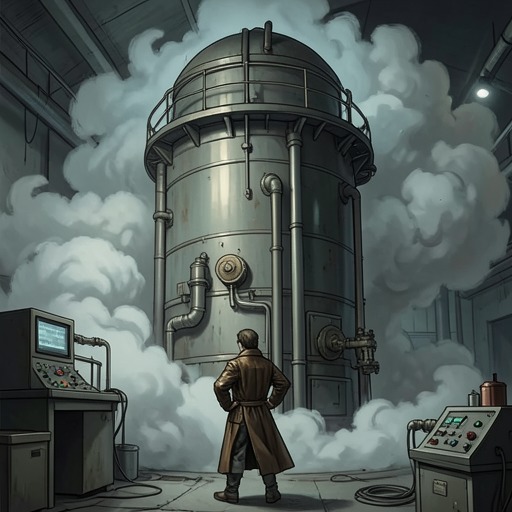
The Ninth ray is described as one of the beautiful scintillations emanating from the great stone in the diadem of the keeper of the atmosphere plant. Instruments finely adjusted on the roof of the vast building separate it from the sun’s other rays. Three-quarters of the building is given over to reservoirs in which the ray is stored, making the plant not simply a machine but a massive storehouse for the force that supports life on Barsoom.
Before the ray is released into the planetary system, it is treated electrically: refined electric vibrations are incorporated into it in specified proportions. Pumps then send the resulting compound to Barsoom’s five principal air centers. Only on release, when it meets the ether of space, does it become atmosphere. The process links celestial energy, careful measurement, electrical treatment, and mechanical distribution in a single chain; the breathable air of the planet is the outcome of that coordinated system.
Reserve and Stewardship
The plant always holds enough stored Ninth ray to maintain the current atmosphere for a thousand years. This immense reserve makes depletion seem remote, but the keeper identifies a different danger: an accident to the pumping apparatus. The distinction matters. Barsoom possesses enough raw material for continued atmospheric supply, yet that abundance is useful only while the equipment can move and transform it.
The vulnerability is sharpened by the plant’s guarded design. Its walls are 150 feet thick, and a five-foot-thick glass covering protects the roof against attack from aircraft. The keeper and one assistant divide the watch, each spending half a Martian year—about 344 Earth days—alone in the isolated facility. Twenty radium pumps stand in an inner chamber; any one of them could furnish the entire planet with atmosphere, and they are used in rotation, each for a little more than one Barsoomian day. The arrangement provides redundancy in the pumps, but the plant’s security and the continuity of its operation remain essential to planetary survival.
Crisis and Narrative Consequence
The system’s hidden fragility becomes a public emergency when the keeper fails to report for two days and the assistant keeper is found dead, horribly mutilated, in the pits beneath his house. A search by a thousand cruisers ends with the discovery of his body, while the absence of communication from the plant leaves the governments of Barsoom without reassurance. The instruments then show air pressure decreasing across the planet: the engine has stopped.
The crisis makes the Ninth ray’s reserve an insufficient safeguard. Stored energy cannot sustain life if the machinery that pumps it through the system is inactive. The atmosphere plant’s formidable walls mean that reaching the machinery would take months, even as the pressure is already falling. The planet’s fate thus turns on access, knowledge, and the functioning of a device rather than on the exhaustion of its energy source.
The Forgotten Key
At the height of the emergency, as Dejah Thoris lies dying in John Carter’s arms, a series of nine long-forgotten sounds rises into his conscious mind. He recognizes them as the key to the atmosphere plant’s three great doors and immediately asks Tardos Mors for the fastest flier, declaring that he can still save Barsoom. The revelation converts the plant’s security from an abstract engineering fact into the immediate obstacle of the climax: survival depends on recovering a forgotten means of entry before the falling air pressure becomes fatal.
The Ninth ray therefore joins wonder to peril. Its immense reserve and elaborate technology make the planet’s atmosphere seem durable, but the failure of a single essential mechanism exposes how that durability depends on carefully maintained infrastructure. The ray is not merely an explanation for how Barsoom has air; it is the material center of a crisis in which knowledge of the system, access to its machinery, and the ability to restore its operation become inseparable from planetary survival.